Helpfull: A Refined Script Font for Elegant Brand Identity
It was one of those quiet Monday mornings—coffee poured, brand board open, and a new client project waiting: a small-batch botanical skincare line launching in three months. The brief asked for warmth, authenticity, and quiet luxury—not loud or trendy, but grounded, intentional, and gently expressive. I opened my font library, scrolled past the usual suspects, and paused on Helpfull. Not because it was new, but because its name felt like a quiet promise.
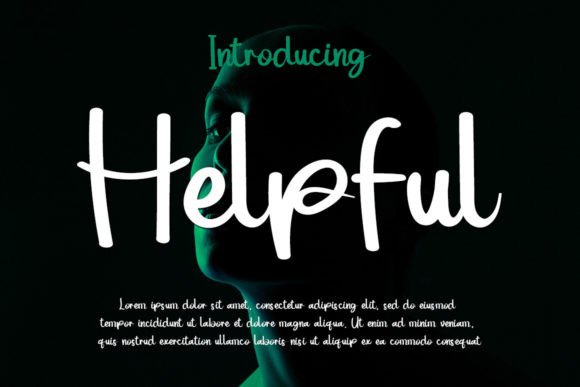
Helpfull is a script font with real presence—fluid, confident, and thoughtfully crafted. Its strokes swell and taper with organic rhythm, mimicking the subtle pressure and lift of ink on paper. There’s no forced quirkiness here; no exaggerated loops or distracting flourishes. Instead, it balances elegance with approachability—graceful enough for a ceramic label, warm enough for a handwritten note tucked into a gift box.
I started where I always do: the logo lockup. Typed “botanical” in Helpfull at 48pt, then adjusted letter spacing to let the connections breathe. Instantly, the word felt like a signature—not a logo slapped on, but something that belonged. The natural entry and exit strokes made it easy to integrate with a simple leaf motif, and the contrast between its soft curves and a crisp sans serif (I used a neutral geometric sans for body copy) created immediate visual hierarchy without competing.
That’s where Helpfull shines most clearly: as a display font and logo typeface. It’s not built for paragraphs or long-form web text—it’s designed for moments that land. A shop sign? Yes—especially when scaled large and set against natural wood or matte ceramic. A business card? Absolutely, especially for the name or tagline. Product labels? Perfect for front-facing hero text—think “Lavender + Chamomile Serum” arcing elegantly across a frosted glass bottle. But I’d never use it for ingredient lists or legal disclaimers. That’s not a limitation—it’s intentionality.
What surprised me during testing was how well Helpfull held up across surfaces and sizes. On a textured kraft paper sticker, its fine details stayed legible. On an Instagram post banner (1080×1350), it retained its character even at smaller headline sizes—no pixelation, no awkward thinning. And on a website hero section, paired with a light-weight serif for subhead and a clean sans for buttons, it gave the whole layout emotional weight without sacrificing clarity.
Helpfull belongs to the Script Amp category—a thoughtful evolution of classic script fonts, optimized for modern design systems. It includes stylistic alternates and common ligatures (like “fi”, “fl”, and “ct”), which add polish when enabled in design apps like Illustrator or Figma. I toggled them on for the logo and packaging mockups, and the difference was subtle but meaningful—smoother joins, more natural rhythm. No multilingual glyphs beyond basic Latin, so it’s ideal for English-first branding, but not suited for global rollouts requiring extended language support.
Font pairing is where Helpfull becomes truly versatile. I tested three combinations across the brand suite:
- A warm serif—like a low-contrast Garamond variant—for editorial pieces and ingredient storytelling. The contrast elevated both typefaces: Helpfull brought movement, the serif brought trust and tradition.
- A restrained sans serif—clean, slightly rounded, with open apertures—for UI elements, web navigation, and product descriptions. This kept the system grounded and accessible.
- No secondary font at all—just Helpfull in varying weights and sizes—for social media quote graphics and limited-edition packaging. Sometimes simplicity is the strongest statement.
One practical tip I’ll pass along: always test Helpfull in context before locking it into your brand guidelines. Drop it into a real mockup—not just a font sampler. Try it on a sample business card printed at actual size. Paste it into a Canva template your client might use later. See how it renders on mobile Safari versus Chrome. I caught one minor kerning hiccup between “o” and “u” in “botanical”—easily adjusted manually, but worth spotting early.
Licensing is straightforward: Helpfull is a commercial font, meaning it’s cleared for client work, merchandise, digital templates, and printed marketing assets—as long as you’ve purchased a valid license. No hidden restrictions for social posts or e-commerce banners. Just make sure your license covers the intended usage scale (e.g., single designer vs. full studio). File formats include OTF and WOFF2, so it works seamlessly in both desktop design tools and web projects.
In the end, Helpfull didn’t just *fit* the project—it helped define its tone. When the client saw the first round of mockups—the logo on a linen tote, the label on a hand-poured candle, the Instagram story with softly animated text—they said, “That feels like us.” That’s the quiet power of a well-chosen script font: it doesn’t shout identity—it invites recognition.
For designers building brands with care—not speed—Helpfull is more than a pretty face. It’s a tool that rewards attention to detail, supports thoughtful hierarchy, and quietly elevates everyday touchpoints. Whether you’re designing for a handmade ceramics studio, a neighborhood café, a creative consultancy, or a slow-fashion label, it brings cohesion without cliché. And in a world saturated with overdesigned fonts, that kind of restraint feels refreshingly helpful.